Everybody has heard that we are made in the image and likeness of God, but what does that really mean anyway? It means war!
Okay, let me back up a minute. I had a great conversation the other day with a good friend of mine and we were talking about why the Devil attacks us so badly. As we talked, we really began to look into the differences between angels and humans.
Angels (the Devil and his demons being fallen angels) are pure spirits. That means that they have an intellect and free will. In other words, they can know and love. Obviously, the Devil and his demons have rejected truth and love in their falling. This means that fallen angels are really failed-angels or defective-angels. They’re not what the used to be and definitely not what God made them to be!
Humans, however, are not pure spirits but are nevertheless spiritual. In humanity is the union between spirit and matter. Our material bodies are united and enlivened by our spiritual souls. Thus we can not only know and love like the angels but we can also experience five senses like the animals. What’s more, being that we belong to the same species, a man and woman can unite in marriage and bring new life into existence.
Angels can’t do that.
In fact, each angel is its own species – which thereby prevents any real union between angels. Humans on the other hand truly are made in the image and likeness of God. Just as God is a Trinity of Persons in a communion of life and love with each other, humans through marriage can image and experience that triune communion through procreation, where the union of two makes three.
That’s a major reason the Devil hates humanity so badly – and it’s a big reason why he attacks marriage and sexuality. He plans to destroy marriage and sexuality in order to mutilate humanity as the image and likeness of God.
Our Counterstrategy: Theology of the Body. Pope John Paul II wrote the Theology of the Body as a means to understand who God is through the physical body – specifically through the person of Jesus Christ, the only human is also God. In Christ, we can truly know who God is and understand what it means to be a human with a body. This theology gives us an eternal look at the truths of sexuality and is a powerful tool against the work of the Devil.
Wednesday, July 2, 2008

Monday, June 23, 2008
War or 24?
So I’m not saying I have a concrete answer on this one, but on the surface I’d have to say that the wars in Afghanistan and Iraq ended with the defeats of the Taliban and Saddam, respectively. What we see today is counter-insurgency or counter-terrorism. It’s less like war and more like 24.
Okay, part of me says: if we’re using tanks, artillery and combat aircraft, then it’s a war. But at the same time, wars are fought against nation-states not terrorist groups. So again I’m thinking it’s what 24 would be if Jack Bauer was given bunker busters (gee, I hope they do that in season seven!).
Now as it comes to capturing terrorists and placing them in Guantanamo, I would think they should be turned over to the governing state in which they were caught, tried, and imprisoned. Isn’t that what we’d do if we caught a person planning to attack another country? Or would the terrorist be extradited to the country he planned to attack? In either case, he would face some sort of trial and then imprisonment or freedom. In any case, it comes down to definition. What are we in: a counter-terrorism effort or full scale war?
The same thing goes when talking about theology.
Many arguments blow up when people misunderstand each other. Luther’s definition of faith was a combination of the Catholic Church’s definitions for faith, hope, and love. So when Catholicism preached the necessity of faith, hope, and love – they largely agreed with Luther’s faith alone idea.
Sometimes, however, there is full understanding and still legitimate disagreement. Continuing with the Luther-Catholic example, Luther taught that saved souls are merely covered by grace outside the soul while Catholics believe that grace actually enters the soul and totally cleanses it from sin. Hence, while Luther said one who is saved is just a “dunghill covered in snow” (that is, a sinful soul covered in grace), Catholics talk about the glory of the saints and the need for purgatory to cleanse one after death.
Advances in dialogue are now taking place between Lutherans and Catholics – but it’s only because terms are being clearly defined. So I may not have all the answers but I think I have a good idea: let’s start making definitions and first principles, laying a foundation for real dialogue and real solutions.
Okay, part of me says: if we’re using tanks, artillery and combat aircraft, then it’s a war. But at the same time, wars are fought against nation-states not terrorist groups. So again I’m thinking it’s what 24 would be if Jack Bauer was given bunker busters (gee, I hope they do that in season seven!).
Now as it comes to capturing terrorists and placing them in Guantanamo, I would think they should be turned over to the governing state in which they were caught, tried, and imprisoned. Isn’t that what we’d do if we caught a person planning to attack another country? Or would the terrorist be extradited to the country he planned to attack? In either case, he would face some sort of trial and then imprisonment or freedom. In any case, it comes down to definition. What are we in: a counter-terrorism effort or full scale war?
The same thing goes when talking about theology.
Many arguments blow up when people misunderstand each other. Luther’s definition of faith was a combination of the Catholic Church’s definitions for faith, hope, and love. So when Catholicism preached the necessity of faith, hope, and love – they largely agreed with Luther’s faith alone idea.
Sometimes, however, there is full understanding and still legitimate disagreement. Continuing with the Luther-Catholic example, Luther taught that saved souls are merely covered by grace outside the soul while Catholics believe that grace actually enters the soul and totally cleanses it from sin. Hence, while Luther said one who is saved is just a “dunghill covered in snow” (that is, a sinful soul covered in grace), Catholics talk about the glory of the saints and the need for purgatory to cleanse one after death.
Advances in dialogue are now taking place between Lutherans and Catholics – but it’s only because terms are being clearly defined. So I may not have all the answers but I think I have a good idea: let’s start making definitions and first principles, laying a foundation for real dialogue and real solutions.
Why God HAD to Protect Mary from Sin
God can do whatever He wants, right? Well he obviously can’t make a square-triangle or walk through a door and not walk through a door at the same time. In other words, the law of non-contradiction applies as much to God as to us. But can God be forced to do something? Well ordinarily, no.
But here’s one good example to the contrary: Mary.
One apologetic for the Immaculate Conception (which means that Mary was protected from sin at the moment of her conception to the present day) is the simple question: if you had the power to make your mother how ever you wanted, wouldn’t you make her the best you could? We can’t – but since God is all-powerful and all holy, Mary must have been sustained in God’s grace her entire life. It’s a good argument. It’s also supported by the Greek word kecharitomene, a perfect passive participle used in Luke 1:28 to describe Mary as “full of grace”. That word literally means that Mary was always filled with God’s grace, from her conception on.
But the argument, though supported by Scripture, leaves it up to God’s discretion. What if I were to argue that God HAD to preserve Mary from sin? Okay, first off let me say that I’m in no way arguing against God’s free and sovereign will here. What I’m getting at is this: If God promises to make Mary all the things Catholics believe her to be, then He must keep His promise. You may be wondering where in the Gospels God promised us this Immaculate Mother.
It’s not in the four Gospels. It’s not in the New Testament. It’s not even in the prophetic or historical books of the Old Testament.
To find the promise you have to go back to the third chapter of Genesis, when sin enters the world. We all remember that God kicked Adam and Eve out of the Garden, but do we remember what God said to the Devil? Genesis 3:15 is the often called the protoevangelium, or proto/first Gospel, in which God promises to defeat the Devil through a messiah figure. Here’s the verse: “I [God] will put enmity between you [the Devil] and woman, between your offspring [sin and death] and hers [the messiah]. He will crush your head while you strike his heal.”
If you ever wondered why Jesus crushes the head of the snake at the beginning of the Passion of the Christ, that’s why. In the scene, the Devil asks Jesus: “Who are you?” By crushing the head of the snake, Jesus is saying: “I’m the fulfillment of the protoevangelium.” And as you watch the movie, there is great emphasis on Mary, the “woman” referred to in the prophesy. That’s why Jesus is always calling Mary “woman” – not to be derogatory but to refer to her role in the protoevangelium. [And by the way, the striking of the heal in the verse refers to Jesus' passion, death, and resurrection.]
Okay, so God promised Mary. What does that have to do with the Immaculate Conception? Everything. God promised that there would be “enmity between [the Devil] and [Mary].” The word used for this enmity is total, complete, and perfect. According to God’s promise, there could at no time be a lack of enmity between Mary and the Devil. That means no sin, for by sinning Mary would fight for the Devil as his ally.
So God, by freeing binding Himself in promise in Genesis 3:15, HAD to give us the gift of our Immaculate Mother – and what a gift indeed!
But here’s one good example to the contrary: Mary.
One apologetic for the Immaculate Conception (which means that Mary was protected from sin at the moment of her conception to the present day) is the simple question: if you had the power to make your mother how ever you wanted, wouldn’t you make her the best you could? We can’t – but since God is all-powerful and all holy, Mary must have been sustained in God’s grace her entire life. It’s a good argument. It’s also supported by the Greek word kecharitomene, a perfect passive participle used in Luke 1:28 to describe Mary as “full of grace”. That word literally means that Mary was always filled with God’s grace, from her conception on.
But the argument, though supported by Scripture, leaves it up to God’s discretion. What if I were to argue that God HAD to preserve Mary from sin? Okay, first off let me say that I’m in no way arguing against God’s free and sovereign will here. What I’m getting at is this: If God promises to make Mary all the things Catholics believe her to be, then He must keep His promise. You may be wondering where in the Gospels God promised us this Immaculate Mother.
It’s not in the four Gospels. It’s not in the New Testament. It’s not even in the prophetic or historical books of the Old Testament.
To find the promise you have to go back to the third chapter of Genesis, when sin enters the world. We all remember that God kicked Adam and Eve out of the Garden, but do we remember what God said to the Devil? Genesis 3:15 is the often called the protoevangelium, or proto/first Gospel, in which God promises to defeat the Devil through a messiah figure. Here’s the verse: “I [God] will put enmity between you [the Devil] and woman, between your offspring [sin and death] and hers [the messiah]. He will crush your head while you strike his heal.”
If you ever wondered why Jesus crushes the head of the snake at the beginning of the Passion of the Christ, that’s why. In the scene, the Devil asks Jesus: “Who are you?” By crushing the head of the snake, Jesus is saying: “I’m the fulfillment of the protoevangelium.” And as you watch the movie, there is great emphasis on Mary, the “woman” referred to in the prophesy. That’s why Jesus is always calling Mary “woman” – not to be derogatory but to refer to her role in the protoevangelium. [And by the way, the striking of the heal in the verse refers to Jesus' passion, death, and resurrection.]
Okay, so God promised Mary. What does that have to do with the Immaculate Conception? Everything. God promised that there would be “enmity between [the Devil] and [Mary].” The word used for this enmity is total, complete, and perfect. According to God’s promise, there could at no time be a lack of enmity between Mary and the Devil. That means no sin, for by sinning Mary would fight for the Devil as his ally.
So God, by freeing binding Himself in promise in Genesis 3:15, HAD to give us the gift of our Immaculate Mother – and what a gift indeed!
Tuesday, June 17, 2008
Safe Religon
Unfortunately the Devil has done a good job of blanketing our society with a contraceptive mentality. But closing ourselves off to new physical life is also being done on a spiritual level as well.
It’s nothing new
In Exodus 20:18-21, God’s chosen people receive the Ten Commandments then distance themselves from God’s presence on the mountain. They wanted to be close to God, but not too close. They practiced “safe religion” – after all, it’s much easier to follow a list of rules than be in a real relationship. God wanted to make them a kingdom of priests, but they withdrew from Him and eventually worshiped a golden calf instead. In one sense, a statue is even better; it doesn’t make any moral demands on you. Except perhaps for cult prostitution – and the people we more than happy to engage in that sin!
But the practice of “safe sex” today is very much a physical manifestation of the old sin of “safe religion” practiced by God’s chosen people on the mountain. Many pre-Vatican II Catholics were practicing “safe-religion” in their devotion to God which in many cases meant doing the rituals externally without acting out of love of God in the heart. When asked, “Why do you do such and such?” The response would be: “Because the Church does it that way; and if you don’t do it too you’ll go to hell!”
The reason we do everything we do as Catholics is so that God’s life-giving presence in our souls will grow ever more abundantly. By being in state of grace, the very Trinity dwells within us, making us holy. In fact, every time we are properly disposed and receive a sacrament, God is intimately working in our very souls! “Safe religion” is simply an impossibility for Catholics.
One poet referred to Jesus by saying something like: He turns water in to wine and wine into blood – what would do with me?! God wants to enter into us and produce new life, just as a good husband enters into his wife to produce new life. It has always been held that we get out of the sacraments what we put in. Or in other words, the amount of grace we receive is partially dependant upon the barriers we put up to God’s grace.
There is enough grace in the proper reception of one Eucharist to make us saints. Why then are we not saints? Because we fall into the practice of “safe religion” – we want to control our life-giving relationship with God just as many couples want to control their life-giving sexual relationship.
I would think that refuting “safe religion” would be one tactic in refuting “safe sex”. In both cases, we must remember the mission of Christ: “I came so that they might have life and have it more abundantly” (John 10:10).
It’s nothing new
In Exodus 20:18-21, God’s chosen people receive the Ten Commandments then distance themselves from God’s presence on the mountain. They wanted to be close to God, but not too close. They practiced “safe religion” – after all, it’s much easier to follow a list of rules than be in a real relationship. God wanted to make them a kingdom of priests, but they withdrew from Him and eventually worshiped a golden calf instead. In one sense, a statue is even better; it doesn’t make any moral demands on you. Except perhaps for cult prostitution – and the people we more than happy to engage in that sin!
But the practice of “safe sex” today is very much a physical manifestation of the old sin of “safe religion” practiced by God’s chosen people on the mountain. Many pre-Vatican II Catholics were practicing “safe-religion” in their devotion to God which in many cases meant doing the rituals externally without acting out of love of God in the heart. When asked, “Why do you do such and such?” The response would be: “Because the Church does it that way; and if you don’t do it too you’ll go to hell!”
The reason we do everything we do as Catholics is so that God’s life-giving presence in our souls will grow ever more abundantly. By being in state of grace, the very Trinity dwells within us, making us holy. In fact, every time we are properly disposed and receive a sacrament, God is intimately working in our very souls! “Safe religion” is simply an impossibility for Catholics.
One poet referred to Jesus by saying something like: He turns water in to wine and wine into blood – what would do with me?! God wants to enter into us and produce new life, just as a good husband enters into his wife to produce new life. It has always been held that we get out of the sacraments what we put in. Or in other words, the amount of grace we receive is partially dependant upon the barriers we put up to God’s grace.
There is enough grace in the proper reception of one Eucharist to make us saints. Why then are we not saints? Because we fall into the practice of “safe religion” – we want to control our life-giving relationship with God just as many couples want to control their life-giving sexual relationship.
I would think that refuting “safe religion” would be one tactic in refuting “safe sex”. In both cases, we must remember the mission of Christ: “I came so that they might have life and have it more abundantly” (John 10:10).
Saturday, June 14, 2008
In Case You Were Wondering
I posted on Facebook the other day something about having fun with my religion students when the police showed up.
Well last weekend I was able to catch up with some old religion students from a couple years ago. It was great! But the story really goes back about a month ago...
I've recently taken up jogging. One night I was out on the high school track and saw a couple figures coming around the side of the school. I wasn't sure what they were up to but figured it may not be good when they noticed me walking and ran away! I thought about calling the police but just figured it was a senior prank and there was nothing to worry about.
So I was telling this story to my old students and two of 'em yelled: "That was you?!" We eventually went out cruising in my Mustang and happened to drop by the high school where we proceeded to joke about the whole thing! It was great. Then the cops stopped by to make sure we weren't getting into any trouble and I just knew we were having way too much fun!
So that's the explanation of my post on Facebook!
Well last weekend I was able to catch up with some old religion students from a couple years ago. It was great! But the story really goes back about a month ago...
I've recently taken up jogging. One night I was out on the high school track and saw a couple figures coming around the side of the school. I wasn't sure what they were up to but figured it may not be good when they noticed me walking and ran away! I thought about calling the police but just figured it was a senior prank and there was nothing to worry about.
So I was telling this story to my old students and two of 'em yelled: "That was you?!" We eventually went out cruising in my Mustang and happened to drop by the high school where we proceeded to joke about the whole thing! It was great. Then the cops stopped by to make sure we weren't getting into any trouble and I just knew we were having way too much fun!
So that's the explanation of my post on Facebook!
Thursday, June 5, 2008
Why Jesus is Important
Okay, there are many reasons. But one forgotten reason I think relates to both liberals and conservatives. Conservatives so often image God as this angry judge, just ready to lay the smack down on wicked sinners. Liberals, on the other hand, have watered down God to a wimpy grandpa God. I think Jesus is the answer to both problems. Jesus as divine and human. Let's look at the Gospel of John: "No one has ever seen God. The only Son, God, who is at the Father's side, has revealed him" (John 1:18).
Do you want to know what God is like? Look at Jesus. Do you want to know what it means to be a human being? Look at Jesus. This what makes Christianity so different from other religions. It's what makes Christianity better than other religions. It's what makes other religions ultimately false. Buddha might have been a nice guy - but he wasn't God.
For those of you who have been told that God is angry and judgmental, look at the mercy and compassion of Jesus and remember that whoever has seen Jesus, has seen the Father. Like Father, like Son.
For those of you who have been told that God is "nice" and doesn't demand much out of you, think about real love, commitment, humility, and self-sacrifice. The thing that made God "nice" was the death of Jesus on the cross. That's what true love is. That's the love we have to image every day. We have to lay down our lives, our wishes, our desires, and even our dreams, for the good of others.
Got it?
Do you want to know what God is like? Look at Jesus. Do you want to know what it means to be a human being? Look at Jesus. This what makes Christianity so different from other religions. It's what makes Christianity better than other religions. It's what makes other religions ultimately false. Buddha might have been a nice guy - but he wasn't God.
For those of you who have been told that God is angry and judgmental, look at the mercy and compassion of Jesus and remember that whoever has seen Jesus, has seen the Father. Like Father, like Son.
For those of you who have been told that God is "nice" and doesn't demand much out of you, think about real love, commitment, humility, and self-sacrifice. The thing that made God "nice" was the death of Jesus on the cross. That's what true love is. That's the love we have to image every day. We have to lay down our lives, our wishes, our desires, and even our dreams, for the good of others.
Got it?
Sunday, May 18, 2008
The Intellectual Urban Legend
 In their book Relativism: Feet Firmly Planted in Mid-Air authors Francis J. Beckwith (who recently returned to the Catholic Church after spending around thirty years as an evangelical) and Gregory Koukl described moral relativism as "an intellectual urban legend."
 Moral relativism has deceived the majority of Western society. Many who proclaim it have never thought to question it but have gone on believing it because it teaches them to do whatever feels good - which feels like a good way to live life. Others who practice relativism hit bottom and see how shallow their lives have become. Most people who hold a view of moral relativism were simply taught it - or caught it, like a virus. It came from bad example and bad logic. It It came from a false understanding of "tolerance." It came from the justification of sin.
Relativism is taught and lived as if it were true. In fact, it is a logical self-contradiction. Moral relativism teaches that morality is simply about values and opinions. Don't impose yours on me! People ask: "Who are you to judge my values?" But to make this judgment universally for all means that there is a moral law appliciable to everyone: "Thou shalt not impose one's morality on another" says the god of tolerance and relativism. But that absolute law refutes relativism. Relativism teaches there are NO absolute laws. But here is a law. Therefore relativism is a logical self-contradiction. People teach relativism as if it were true, passing it around like an... an...
...an intellectual urban legend!
Wednesday, May 14, 2008
A Milestone in Catholic-Evangelical Dialogue
In a stunning move, John Hagee, an influential televangelist and McCain supporter, rejected his anti-Catholic views! This, of course, is not getting the media attention it should, being that it will further McCain’s lead in the religion department – particularly when it comes to Obama’s “Wright-gate” controversy.
What makes this so stunning is the fact that anti-Catholicism is a staple of Biblical fundamentalism – particularly when it comes to eschatology, the study of the last things or end times.
Democrats have been eying the Catholic vote over the past four years. If you did’t know, George W. Bush won the Catholic vote in 2000 against Al Gore and in 2004 against John Kerry – a Catholic. A controversy like John Hagee could have daunted McCain through the summer and fall, particularly against Hilary Clinton who has dominated Democrat Catholics. However, now that it appears that Obama will win the nomination, Hagee is another sign that Catholics and Evangelicals will rally behind McCain in November.
You may be wondering what anti-Catholic teachings Hagee has held and taught for many years. Two big issues are titles for the Catholic Church: the “apostate church” and the “whore of Babylon.” In fundamentalist circles, these titles naturally are given to the Catholic Church because of rapture theology and a low-view of hierarchic ecclesiology. Jesus and the first century Christians spoke of the Church with great esteem – and since the only ancient church is the Catholic Church, which Protestants are not in union with, then the Catholic Church must be apostate. Apostate here means that the Catholic Church hijacked ancient, first century Christianity and added pagan practices to it. So, really, either the Catholic Church is the true Church or it is an apostate church and the whore of Babylon for adding pagan ideas to Christianity.
Take your pick.
Thus this is why it is so stunning for Hagee to renounce his former views. If you’re a staunch fundamentalist, you should naturally have an anti-Catholic viewpoint. Some people may claim Hagee is just being political. I don’t think so. That would be like President Bush getting on TV tomorrow and to announce he was becoming an Independent. Not gonna happen. In the words of Bill Donahue: "What Hagee has done takes courage and quite frankly I never expected him to demonstrate such sensitivity to our concerns."
What makes this so stunning is the fact that anti-Catholicism is a staple of Biblical fundamentalism – particularly when it comes to eschatology, the study of the last things or end times.
Democrats have been eying the Catholic vote over the past four years. If you did’t know, George W. Bush won the Catholic vote in 2000 against Al Gore and in 2004 against John Kerry – a Catholic. A controversy like John Hagee could have daunted McCain through the summer and fall, particularly against Hilary Clinton who has dominated Democrat Catholics. However, now that it appears that Obama will win the nomination, Hagee is another sign that Catholics and Evangelicals will rally behind McCain in November.
You may be wondering what anti-Catholic teachings Hagee has held and taught for many years. Two big issues are titles for the Catholic Church: the “apostate church” and the “whore of Babylon.” In fundamentalist circles, these titles naturally are given to the Catholic Church because of rapture theology and a low-view of hierarchic ecclesiology. Jesus and the first century Christians spoke of the Church with great esteem – and since the only ancient church is the Catholic Church, which Protestants are not in union with, then the Catholic Church must be apostate. Apostate here means that the Catholic Church hijacked ancient, first century Christianity and added pagan practices to it. So, really, either the Catholic Church is the true Church or it is an apostate church and the whore of Babylon for adding pagan ideas to Christianity.
Take your pick.
Thus this is why it is so stunning for Hagee to renounce his former views. If you’re a staunch fundamentalist, you should naturally have an anti-Catholic viewpoint. Some people may claim Hagee is just being political. I don’t think so. That would be like President Bush getting on TV tomorrow and to announce he was becoming an Independent. Not gonna happen. In the words of Bill Donahue: "What Hagee has done takes courage and quite frankly I never expected him to demonstrate such sensitivity to our concerns."
What's more important, however, is not that McCain will gain some political points, but rather that Hagee's change of heart will help further the dialoge between Evangelicals and Catholics.
Monday, May 12, 2008
Well, It Appears Democrats’ Brains Are Smaller Than I Thought
Please, don’t take that the wrong way!
What I mean is that the Democrats are poised to nominate the total loser Barack Obama as their nominee for President in 2008. Okay, maybe he’s not a total loser – but he’s no where near the candidate that Hilary Clinton is. Sure, Obama has his message of “hope” and all that “look to the future” baloney. It just proves he’s a sleazier politician than Hilary.
But at least Hilary has some experience behind her. Obama hasn’t even finished one term as a U.S. Senator! Let’s not forget that, like it or not, there is a war going on. Even if you’re against the war I would still trust Hilary over Obama to handle an exit-strategy.
And then there’s Jeremiah Wright. Enough said.
So what I’m getting here is this: Yes, it looks like a Democratic year. But there has to be someone better than Obama to run! In the end, Operation Chaos I believe will pay off and many of Hilary’s moderate supporters (along with Catholics, myself included) will swing over to McCain, bringing him to a November win.
And just to be clear, I quiver at thought of supporting Obama or Clinton!!
What I mean is that the Democrats are poised to nominate the total loser Barack Obama as their nominee for President in 2008. Okay, maybe he’s not a total loser – but he’s no where near the candidate that Hilary Clinton is. Sure, Obama has his message of “hope” and all that “look to the future” baloney. It just proves he’s a sleazier politician than Hilary.
But at least Hilary has some experience behind her. Obama hasn’t even finished one term as a U.S. Senator! Let’s not forget that, like it or not, there is a war going on. Even if you’re against the war I would still trust Hilary over Obama to handle an exit-strategy.
And then there’s Jeremiah Wright. Enough said.
So what I’m getting here is this: Yes, it looks like a Democratic year. But there has to be someone better than Obama to run! In the end, Operation Chaos I believe will pay off and many of Hilary’s moderate supporters (along with Catholics, myself included) will swing over to McCain, bringing him to a November win.
And just to be clear, I quiver at thought of supporting Obama or Clinton!!
Saturday, May 3, 2008
In Politics, No Catholic Could Do This...
Or maybe I mean no Republican Catholic could do this.
Of course I'm speaking to the fact that the Democratic presidential candidate, Barack Obama, now has the open support of thirty prominent African American preachers in Chicago. Obviously these preachers are fearing the damage being done to Obama by the Jeremiah Wright controversy. In case you forgot, the bigoted hate-speech of Jeremiah Wright - Obama's former pastor - have recently come to light. It doesn't help that Wright has since alluded that Obama really agrees with his hate-speech but cannot openly say so because of politics! Whether or not Obama agrees with Wright pales in the face of recent polls which indicate that nearly fifty percent of Democrats and Independents believe Obama does, in fact, agree with Wright. What's more, a vast majority of those polled believe Obama is ending his twenty-year relationship with Wright for purely political reasons.
Enter the African American pastors.
While it is honorable that these thirty prominent pastors seek to support someone in his time of personal woe, I think there is an issue of the division of church and state. If thirty Catholic priests here in Arizona were to stand up and support John McCain, they would be denounced and their parishes would face a loss of tax-exempt status. The same would be true if someone like Jeb Bush, a Catholic, were running.
The fact is, these Chicago churches have long brought politics and religion together. This union of the thirty pastors is simply another example of liberal churches influencing members of their community to vote for a specific candidate. What really bothers me is the hypocrisy of Democrats who tell people in the church's who to vote for while yelling at the Catholic Church for denouncing Catholic politicians within the Church (both Democrats and Republicans) who openly support intrinsically evil acts like abortion, embryonic stem cell research, and euthanasia.
Of course I'm speaking to the fact that the Democratic presidential candidate, Barack Obama, now has the open support of thirty prominent African American preachers in Chicago. Obviously these preachers are fearing the damage being done to Obama by the Jeremiah Wright controversy. In case you forgot, the bigoted hate-speech of Jeremiah Wright - Obama's former pastor - have recently come to light. It doesn't help that Wright has since alluded that Obama really agrees with his hate-speech but cannot openly say so because of politics! Whether or not Obama agrees with Wright pales in the face of recent polls which indicate that nearly fifty percent of Democrats and Independents believe Obama does, in fact, agree with Wright. What's more, a vast majority of those polled believe Obama is ending his twenty-year relationship with Wright for purely political reasons.
Enter the African American pastors.
While it is honorable that these thirty prominent pastors seek to support someone in his time of personal woe, I think there is an issue of the division of church and state. If thirty Catholic priests here in Arizona were to stand up and support John McCain, they would be denounced and their parishes would face a loss of tax-exempt status. The same would be true if someone like Jeb Bush, a Catholic, were running.
The fact is, these Chicago churches have long brought politics and religion together. This union of the thirty pastors is simply another example of liberal churches influencing members of their community to vote for a specific candidate. What really bothers me is the hypocrisy of Democrats who tell people in the church's who to vote for while yelling at the Catholic Church for denouncing Catholic politicians within the Church (both Democrats and Republicans) who openly support intrinsically evil acts like abortion, embryonic stem cell research, and euthanasia.
Saturday, April 19, 2008
The Pope on Education
My aunt was visiting yesterday and politics happened to come up. She is very much a liberal on many issues. And there is nothing intrinsically wrong with this. For the most part, politics should not divide people the way it does. Today, however, politics is entering areas where it shouldn't. Law means legislating morality - but in a culture that rejects morality and a nation which is becoming more secular, some laws and many court rules have become quite opposed to basic morality and the natural law.
Typically the Left argues with the Right over abortion, embryonic stem cell research, and gay marriage. While my aunt is very pro-Life and supportive of the Church, the discussion yesterday focused on just war doctrine and in part on education. My aunt took the typical liberal view that we should spend more money on education and less on the military. I, as a teacher in a Catholic school, had to disagree.
Students at a public high school each receives about $10,000 a year from the tax payer money for their education. Private schools run around $3000-$4,000 per year (obviously not from tax payers!). By looking at the level of education that comes from private school versus a public school shows that money doesn't make a great difference. In other words, raising the amount tax payers spend to $13,000 per student will probably not improve the education of the students. Actually statistics show that more students should be sent to private schools! Hence the need for vouchers.. but that's another topic entirely!
One would wonder what the difference is between a good Catholic school and a public school. I found it interesting that during the discussion the pope was speaking to Catholic educators and I believe he hit the nail on the head on this very question:
"When nothing beyond the individual is recognized as definitive, the ultimate criterion of judgment becomes the self and the satisfaction of the individuals immediate wishes. The objectivity and perspective, which can only come through a recognition of the essential transcendent dimension of the human person, can be lost. Within such a relativistic horizon the goals of education are inevitably curtailed. Slowly, a lowering of standards occurs. We observe today a timidity in the face of the category of the good and an aimless pursuit of novelty parading as the realization of freedom. We witness an assumption that every experience is of equal worth and a reluctance to admit imperfection and mistakes. And particularly disturbing, is the reduction of the precious and delicate area of education in sexuality to management of 'risk', bereft of any reference to the beauty of conjugal love."
In other words: truth, goodness, and beauty are related. We can only subjectivize beauty (especially "the beauty of conjugal love") and relativize morality if we deny any real objective truth. When we say "anything goes" or "different strokes for different folks" we lose the ability to say anything with certainty. Moreover, the very desire for truth within the student is quashed. "What difference does it make?" the student may ask, "All I really want to do is play video games now."
We don't need more money, we need truth, goodness, and beauty. We need God. Unfortunately we won't be finding Him anywhere near a public school these days...
Typically the Left argues with the Right over abortion, embryonic stem cell research, and gay marriage. While my aunt is very pro-Life and supportive of the Church, the discussion yesterday focused on just war doctrine and in part on education. My aunt took the typical liberal view that we should spend more money on education and less on the military. I, as a teacher in a Catholic school, had to disagree.
Students at a public high school each receives about $10,000 a year from the tax payer money for their education. Private schools run around $3000-$4,000 per year (obviously not from tax payers!). By looking at the level of education that comes from private school versus a public school shows that money doesn't make a great difference. In other words, raising the amount tax payers spend to $13,000 per student will probably not improve the education of the students. Actually statistics show that more students should be sent to private schools! Hence the need for vouchers.. but that's another topic entirely!
One would wonder what the difference is between a good Catholic school and a public school. I found it interesting that during the discussion the pope was speaking to Catholic educators and I believe he hit the nail on the head on this very question:
"When nothing beyond the individual is recognized as definitive, the ultimate criterion of judgment becomes the self and the satisfaction of the individuals immediate wishes. The objectivity and perspective, which can only come through a recognition of the essential transcendent dimension of the human person, can be lost. Within such a relativistic horizon the goals of education are inevitably curtailed. Slowly, a lowering of standards occurs. We observe today a timidity in the face of the category of the good and an aimless pursuit of novelty parading as the realization of freedom. We witness an assumption that every experience is of equal worth and a reluctance to admit imperfection and mistakes. And particularly disturbing, is the reduction of the precious and delicate area of education in sexuality to management of 'risk', bereft of any reference to the beauty of conjugal love."
In other words: truth, goodness, and beauty are related. We can only subjectivize beauty (especially "the beauty of conjugal love") and relativize morality if we deny any real objective truth. When we say "anything goes" or "different strokes for different folks" we lose the ability to say anything with certainty. Moreover, the very desire for truth within the student is quashed. "What difference does it make?" the student may ask, "All I really want to do is play video games now."
We don't need more money, we need truth, goodness, and beauty. We need God. Unfortunately we won't be finding Him anywhere near a public school these days...
Thursday, April 10, 2008
True Holiness
 This summer my parish is going to use a Bible study I wrote on the New Testament. I'm so pumped! Basically it's a ten-week overview of the New Testament using the authors Mathew, Paul (and his disciple Luke), Peter (and his disciple Mark), and John. Between these guys is something like 90% of the New Testament. My first talk is both an introduction to reading and interpreting the Bible (along with which translation to use!) while also an introduction to the Old Testament and how it fits into the New via history and typology. In other words, I aim to refute the "mean" Old Testament God with the "nice" New Testament God. This talk really culminates in the second talk which looks at the Gospel of Matthew and how the Jesus and the Church fulfill Old Testament prophesy and types.
 Now when we get into Paul, the students will learn a thing or two about justification, sanctification, and salvation. And what really gets me is when I hear people push the whole faith alone Protestant concept - because it just doesn't fit what the Bible says.
It comes back to what is called "imputed" righteousness. This means that humanity is so injured from the Fall that not even God can repair it. According to Luther our souls are like dunghills. No matter what they will always eternally be dunghills. The most God can do is cover the dung with something that would blind himself from the impurity of our being. That's where Jesus comes in. By faith, we are covered with his righteousness so that when God sees us, he only sees Jesus and Jesus' saving work.
Once Luther took this heretical view, he was quite able to reject indulgences, relics, sacramentals, Purgatory, penance, good works, and many sacraments. Why? Because all of those things are there to truly purify our souls and make us really holy. So when you deny that you can become holy, the tools or means of holiness are no longer necessary. With his theology, we can only become externally or visibly holy - but this is just a docetic holiness; a pseudo-holiness.
I just don't buy it.
And it's not because the Catholic Church condemns it - the Bible does, too. I just re-read Paul's First Letter to the Thessalonians today and can't find a bit about external holiness or faith alone without works. Instead I run into Paul thanking God for the Thessalonians's "work of faith and labor [work] of love" - in verse 3 (emphasis mine)! But more importantly, faith and love are connected because faith helps us take the first steps so that the works of love can make us pure and holy. For example, Paul hopes that God will help the Thessalonians to "abound in love for one another and for all, just as we have for you, so as to strengthen your hearts [that is, your INmost being] to be blameless in holiness before our God..." (1 Thessalonians 3:12-13). So Paul is saying that in coming to God, the people will be truly holy - in their very being!
Chapter four takes the next step: "This is the will of God, your holiness" (verse 3). God's will is also that they should "give thanks" (5:18). Let's see, how might giving thanks tie in with being holy? Could it be that the Greek word for thanksgiving is eucharistia? How about the fact that our primary holiness comes from the reception of this Eucharist?!
But let me conclude this post with the a tad bit from the end of 1 Thessalonians regarding holiness: "May the God of peace himself make you perfectly holy and may you entirely, spirit, soul, and body, be preserved blameless for the coming of our Lord..." (5:23, emphasis mine).
Monday, April 7, 2008
Quote of the Day!
"Knowledge may be power but wisdom is humility."
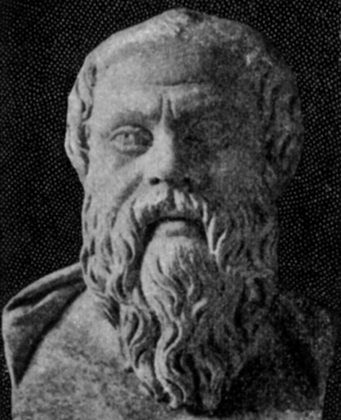 Well I made it up - but I bet Socrates would agree with me if he were alive today! I posted the other day about humanism and its various forms. While secular humanism stresses knowledge and power, classical and theistic humanism would stress wisdom and humility. While Socrates was all about wisdom, Christians are always about humility. And the two are rather linked. Socrates' wisdom was his humility. He knew that he did not know and, unlike the Pharisees of his day, he was humble enough to admit it. His Gospel was: "Know thyself" - and that was what classical humanism was all about. What am I as a human?
Among Christians, there was once a saint who was asked to name the four cardinal virtues. He responded: "humility, humility, humility, and humility." Wisdom and virtue are very important in Christianity - but humility also includes knowing that only in God can we find happiness and only by God's help (via grace) can we find Him.
Secular humanism, beginning especially in Machiavelli, teaches that virtue keeps us from getting what we want. Good guys finish last. Power combined with vice is needed to be successful. Descartes would give us the scientific method to have all the power we want through the knowledge of the world around us. Combine scientific knowledge, vice, and a secular humanist worldview and we have countries like communist Russia, spreading atheism and threatening the world with nuclear war.
While the threat of nuclear war with Russia is no more, the principles of secular humanism have unfortuneately spread. The cold war may be over but the war for men's souls has only begun. The key for victory: the wisdom of humility.
And don't forget for a minute that Jesus Christ is wisdom incarnate...
Well I made it up - but I bet Socrates would agree with me if he were alive today! I posted the other day about humanism and its various forms. While secular humanism stresses knowledge and power, classical and theistic humanism would stress wisdom and humility. While Socrates was all about wisdom, Christians are always about humility. And the two are rather linked. Socrates' wisdom was his humility. He knew that he did not know and, unlike the Pharisees of his day, he was humble enough to admit it. His Gospel was: "Know thyself" - and that was what classical humanism was all about. What am I as a human?Among Christians, there was once a saint who was asked to name the four cardinal virtues. He responded: "humility, humility, humility, and humility." Wisdom and virtue are very important in Christianity - but humility also includes knowing that only in God can we find happiness and only by God's help (via grace) can we find Him.
Secular humanism, beginning especially in Machiavelli, teaches that virtue keeps us from getting what we want. Good guys finish last. Power combined with vice is needed to be successful. Descartes would give us the scientific method to have all the power we want through the knowledge of the world around us. Combine scientific knowledge, vice, and a secular humanist worldview and we have countries like communist Russia, spreading atheism and threatening the world with nuclear war.
While the threat of nuclear war with Russia is no more, the principles of secular humanism have unfortuneately spread. The cold war may be over but the war for men's souls has only begun. The key for victory: the wisdom of humility.
And don't forget for a minute that Jesus Christ is wisdom incarnate...
Saturday, April 5, 2008
Humanism!
Chances are, if you run into someone on the street who calls himself a humanisit, you're talking to an atheist. "Humanism" has thus received a bad reputation among God fearing Christians.
We need to take it back.
The form of humanism above is secular or atheist humanism. The oldest form is aptly called classical humanism. This classical humanism was found in the ancient Greek philosophers like Socrates, Plato, and Aristotle. What these men believed was that the human person was essentially his soul. The soul has two main powers: intellect and will. Perfection would thus naturally come if one perfected the intellect and the will. To do this, classical humanists taught we needed wisdom to perfect the intellect and virtue to perfect the will.
Did Christianity reject this? No way! All we did was add to it by saying that supernatural perfection can only come from God. Only in Him can we find true wisdom (supernatural truths) and virtue (the supernatural theological virtues of faith, hope, and charity). This is called theistic humanism. It was found it's apex in the writings of St Augustine and St. Thomas Aquinas.
The scholastics following St. Thomas in the 14th and 15th centuries, however, began to focus on divine truths, leaving many to wonder about the meaning of our human existence.
Enter the Renaissance.
The Renaissance thinkers began to focus once more on classical humanism. One would suppose this rediscovery of classical thought would lead them back to the theistic humanism of Christianity. Some, however, rejected both classical and theistic humanism in order to deify the human person. To do this, the truths about the human person and about God had to be rejected.
Secular humanism in comparison to classical and theistic humanism is a loss, not a gain. Thus G. K. Chesterton would quip: "Paganism was big, Christianity was bigger. Everything since has been comparatively small."
Through the writings of the nominalist William of Ockham and the political philosopher Machiavelli, spiritual realities (like the soul and God) were rejected. Virtue was seen as an obstacle to success. Power - ultimately divine power - was the new summon bonum. This secular humanism would grow and develop over for hundreds of years, affecting us to this very day.
Freud, the father of modern psychology and secular humanist, would in a sense question secular humanism by asking: "Since we have become gods [through powerful technology] why aren't we happy?"
He forgot the words of St. Augustine: "God has made us for Himself and we are restless until we rest in Him."
We need to take it back.
The form of humanism above is secular or atheist humanism. The oldest form is aptly called classical humanism. This classical humanism was found in the ancient Greek philosophers like Socrates, Plato, and Aristotle. What these men believed was that the human person was essentially his soul. The soul has two main powers: intellect and will. Perfection would thus naturally come if one perfected the intellect and the will. To do this, classical humanists taught we needed wisdom to perfect the intellect and virtue to perfect the will.
Did Christianity reject this? No way! All we did was add to it by saying that supernatural perfection can only come from God. Only in Him can we find true wisdom (supernatural truths) and virtue (the supernatural theological virtues of faith, hope, and charity). This is called theistic humanism. It was found it's apex in the writings of St Augustine and St. Thomas Aquinas.
The scholastics following St. Thomas in the 14th and 15th centuries, however, began to focus on divine truths, leaving many to wonder about the meaning of our human existence.
Enter the Renaissance.
The Renaissance thinkers began to focus once more on classical humanism. One would suppose this rediscovery of classical thought would lead them back to the theistic humanism of Christianity. Some, however, rejected both classical and theistic humanism in order to deify the human person. To do this, the truths about the human person and about God had to be rejected.
Secular humanism in comparison to classical and theistic humanism is a loss, not a gain. Thus G. K. Chesterton would quip: "Paganism was big, Christianity was bigger. Everything since has been comparatively small."
Through the writings of the nominalist William of Ockham and the political philosopher Machiavelli, spiritual realities (like the soul and God) were rejected. Virtue was seen as an obstacle to success. Power - ultimately divine power - was the new summon bonum. This secular humanism would grow and develop over for hundreds of years, affecting us to this very day.
Freud, the father of modern psychology and secular humanist, would in a sense question secular humanism by asking: "Since we have become gods [through powerful technology] why aren't we happy?"
He forgot the words of St. Augustine: "God has made us for Himself and we are restless until we rest in Him."
Monday, March 31, 2008
Pic of the Day!
 Yes that is me. I'm blond now! I can feel my IQ dropping as I type... Or maybe it's because of the vodka. I don't usually drink vodka but since I heard blonds have more fun, I just had to drink some and party with the guys until at least 3 AM every night this past week!
I know the blond is a little different (compared to the my picture on the right side of the blog column) but I like to brighten things up for spring! Who knows, I may even keep it over the summer...
Subscribe to:
Posts (Atom)
