My aunt was visiting yesterday and politics happened to come up. She is very much a liberal on many issues. And there is nothing intrinsically wrong with this. For the most part, politics should not divide people the way it does. Today, however, politics is entering areas where it shouldn't. Law means legislating morality - but in a culture that rejects morality and a nation which is becoming more secular, some laws and many court rules have become quite opposed to basic morality and the natural law.
Typically the Left argues with the Right over abortion, embryonic stem cell research, and gay marriage. While my aunt is very pro-Life and supportive of the Church, the discussion yesterday focused on just war doctrine and in part on education. My aunt took the typical liberal view that we should spend more money on education and less on the military. I, as a teacher in a Catholic school, had to disagree.
Students at a public high school each receives about $10,000 a year from the tax payer money for their education. Private schools run around $3000-$4,000 per year (obviously not from tax payers!). By looking at the level of education that comes from private school versus a public school shows that money doesn't make a great difference. In other words, raising the amount tax payers spend to $13,000 per student will probably not improve the education of the students. Actually statistics show that more students should be sent to private schools! Hence the need for vouchers.. but that's another topic entirely!
One would wonder what the difference is between a good Catholic school and a public school. I found it interesting that during the discussion the pope was speaking to Catholic educators and I believe he hit the nail on the head on this very question:
"When nothing beyond the individual is recognized as definitive, the ultimate criterion of judgment becomes the self and the satisfaction of the individuals immediate wishes. The objectivity and perspective, which can only come through a recognition of the essential transcendent dimension of the human person, can be lost. Within such a relativistic horizon the goals of education are inevitably curtailed. Slowly, a lowering of standards occurs. We observe today a timidity in the face of the category of the good and an aimless pursuit of novelty parading as the realization of freedom. We witness an assumption that every experience is of equal worth and a reluctance to admit imperfection and mistakes. And particularly disturbing, is the reduction of the precious and delicate area of education in sexuality to management of 'risk', bereft of any reference to the beauty of conjugal love."
In other words: truth, goodness, and beauty are related. We can only subjectivize beauty (especially "the beauty of conjugal love") and relativize morality if we deny any real objective truth. When we say "anything goes" or "different strokes for different folks" we lose the ability to say anything with certainty. Moreover, the very desire for truth within the student is quashed. "What difference does it make?" the student may ask, "All I really want to do is play video games now."
We don't need more money, we need truth, goodness, and beauty. We need God. Unfortunately we won't be finding Him anywhere near a public school these days...
Saturday, April 19, 2008

Thursday, April 10, 2008
True Holiness
 This summer my parish is going to use a Bible study I wrote on the New Testament. I'm so pumped! Basically it's a ten-week overview of the New Testament using the authors Mathew, Paul (and his disciple Luke), Peter (and his disciple Mark), and John. Between these guys is something like 90% of the New Testament. My first talk is both an introduction to reading and interpreting the Bible (along with which translation to use!) while also an introduction to the Old Testament and how it fits into the New via history and typology. In other words, I aim to refute the "mean" Old Testament God with the "nice" New Testament God. This talk really culminates in the second talk which looks at the Gospel of Matthew and how the Jesus and the Church fulfill Old Testament prophesy and types.
 Now when we get into Paul, the students will learn a thing or two about justification, sanctification, and salvation. And what really gets me is when I hear people push the whole faith alone Protestant concept - because it just doesn't fit what the Bible says.
It comes back to what is called "imputed" righteousness. This means that humanity is so injured from the Fall that not even God can repair it. According to Luther our souls are like dunghills. No matter what they will always eternally be dunghills. The most God can do is cover the dung with something that would blind himself from the impurity of our being. That's where Jesus comes in. By faith, we are covered with his righteousness so that when God sees us, he only sees Jesus and Jesus' saving work.
Once Luther took this heretical view, he was quite able to reject indulgences, relics, sacramentals, Purgatory, penance, good works, and many sacraments. Why? Because all of those things are there to truly purify our souls and make us really holy. So when you deny that you can become holy, the tools or means of holiness are no longer necessary. With his theology, we can only become externally or visibly holy - but this is just a docetic holiness; a pseudo-holiness.
I just don't buy it.
And it's not because the Catholic Church condemns it - the Bible does, too. I just re-read Paul's First Letter to the Thessalonians today and can't find a bit about external holiness or faith alone without works. Instead I run into Paul thanking God for the Thessalonians's "work of faith and labor [work] of love" - in verse 3 (emphasis mine)! But more importantly, faith and love are connected because faith helps us take the first steps so that the works of love can make us pure and holy. For example, Paul hopes that God will help the Thessalonians to "abound in love for one another and for all, just as we have for you, so as to strengthen your hearts [that is, your INmost being] to be blameless in holiness before our God..." (1 Thessalonians 3:12-13). So Paul is saying that in coming to God, the people will be truly holy - in their very being!
Chapter four takes the next step: "This is the will of God, your holiness" (verse 3). God's will is also that they should "give thanks" (5:18). Let's see, how might giving thanks tie in with being holy? Could it be that the Greek word for thanksgiving is eucharistia? How about the fact that our primary holiness comes from the reception of this Eucharist?!
But let me conclude this post with the a tad bit from the end of 1 Thessalonians regarding holiness: "May the God of peace himself make you perfectly holy and may you entirely, spirit, soul, and body, be preserved blameless for the coming of our Lord..." (5:23, emphasis mine).
Monday, April 7, 2008
Quote of the Day!
"Knowledge may be power but wisdom is humility."
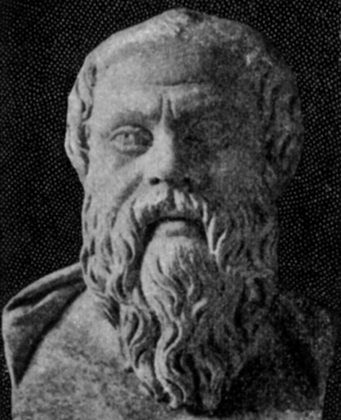 Well I made it up - but I bet Socrates would agree with me if he were alive today! I posted the other day about humanism and its various forms. While secular humanism stresses knowledge and power, classical and theistic humanism would stress wisdom and humility. While Socrates was all about wisdom, Christians are always about humility. And the two are rather linked. Socrates' wisdom was his humility. He knew that he did not know and, unlike the Pharisees of his day, he was humble enough to admit it. His Gospel was: "Know thyself" - and that was what classical humanism was all about. What am I as a human?
Among Christians, there was once a saint who was asked to name the four cardinal virtues. He responded: "humility, humility, humility, and humility." Wisdom and virtue are very important in Christianity - but humility also includes knowing that only in God can we find happiness and only by God's help (via grace) can we find Him.
Secular humanism, beginning especially in Machiavelli, teaches that virtue keeps us from getting what we want. Good guys finish last. Power combined with vice is needed to be successful. Descartes would give us the scientific method to have all the power we want through the knowledge of the world around us. Combine scientific knowledge, vice, and a secular humanist worldview and we have countries like communist Russia, spreading atheism and threatening the world with nuclear war.
While the threat of nuclear war with Russia is no more, the principles of secular humanism have unfortuneately spread. The cold war may be over but the war for men's souls has only begun. The key for victory: the wisdom of humility.
And don't forget for a minute that Jesus Christ is wisdom incarnate...
Well I made it up - but I bet Socrates would agree with me if he were alive today! I posted the other day about humanism and its various forms. While secular humanism stresses knowledge and power, classical and theistic humanism would stress wisdom and humility. While Socrates was all about wisdom, Christians are always about humility. And the two are rather linked. Socrates' wisdom was his humility. He knew that he did not know and, unlike the Pharisees of his day, he was humble enough to admit it. His Gospel was: "Know thyself" - and that was what classical humanism was all about. What am I as a human?Among Christians, there was once a saint who was asked to name the four cardinal virtues. He responded: "humility, humility, humility, and humility." Wisdom and virtue are very important in Christianity - but humility also includes knowing that only in God can we find happiness and only by God's help (via grace) can we find Him.
Secular humanism, beginning especially in Machiavelli, teaches that virtue keeps us from getting what we want. Good guys finish last. Power combined with vice is needed to be successful. Descartes would give us the scientific method to have all the power we want through the knowledge of the world around us. Combine scientific knowledge, vice, and a secular humanist worldview and we have countries like communist Russia, spreading atheism and threatening the world with nuclear war.
While the threat of nuclear war with Russia is no more, the principles of secular humanism have unfortuneately spread. The cold war may be over but the war for men's souls has only begun. The key for victory: the wisdom of humility.
And don't forget for a minute that Jesus Christ is wisdom incarnate...
Saturday, April 5, 2008
Humanism!
Chances are, if you run into someone on the street who calls himself a humanisit, you're talking to an atheist. "Humanism" has thus received a bad reputation among God fearing Christians.
We need to take it back.
The form of humanism above is secular or atheist humanism. The oldest form is aptly called classical humanism. This classical humanism was found in the ancient Greek philosophers like Socrates, Plato, and Aristotle. What these men believed was that the human person was essentially his soul. The soul has two main powers: intellect and will. Perfection would thus naturally come if one perfected the intellect and the will. To do this, classical humanists taught we needed wisdom to perfect the intellect and virtue to perfect the will.
Did Christianity reject this? No way! All we did was add to it by saying that supernatural perfection can only come from God. Only in Him can we find true wisdom (supernatural truths) and virtue (the supernatural theological virtues of faith, hope, and charity). This is called theistic humanism. It was found it's apex in the writings of St Augustine and St. Thomas Aquinas.
The scholastics following St. Thomas in the 14th and 15th centuries, however, began to focus on divine truths, leaving many to wonder about the meaning of our human existence.
Enter the Renaissance.
The Renaissance thinkers began to focus once more on classical humanism. One would suppose this rediscovery of classical thought would lead them back to the theistic humanism of Christianity. Some, however, rejected both classical and theistic humanism in order to deify the human person. To do this, the truths about the human person and about God had to be rejected.
Secular humanism in comparison to classical and theistic humanism is a loss, not a gain. Thus G. K. Chesterton would quip: "Paganism was big, Christianity was bigger. Everything since has been comparatively small."
Through the writings of the nominalist William of Ockham and the political philosopher Machiavelli, spiritual realities (like the soul and God) were rejected. Virtue was seen as an obstacle to success. Power - ultimately divine power - was the new summon bonum. This secular humanism would grow and develop over for hundreds of years, affecting us to this very day.
Freud, the father of modern psychology and secular humanist, would in a sense question secular humanism by asking: "Since we have become gods [through powerful technology] why aren't we happy?"
He forgot the words of St. Augustine: "God has made us for Himself and we are restless until we rest in Him."
We need to take it back.
The form of humanism above is secular or atheist humanism. The oldest form is aptly called classical humanism. This classical humanism was found in the ancient Greek philosophers like Socrates, Plato, and Aristotle. What these men believed was that the human person was essentially his soul. The soul has two main powers: intellect and will. Perfection would thus naturally come if one perfected the intellect and the will. To do this, classical humanists taught we needed wisdom to perfect the intellect and virtue to perfect the will.
Did Christianity reject this? No way! All we did was add to it by saying that supernatural perfection can only come from God. Only in Him can we find true wisdom (supernatural truths) and virtue (the supernatural theological virtues of faith, hope, and charity). This is called theistic humanism. It was found it's apex in the writings of St Augustine and St. Thomas Aquinas.
The scholastics following St. Thomas in the 14th and 15th centuries, however, began to focus on divine truths, leaving many to wonder about the meaning of our human existence.
Enter the Renaissance.
The Renaissance thinkers began to focus once more on classical humanism. One would suppose this rediscovery of classical thought would lead them back to the theistic humanism of Christianity. Some, however, rejected both classical and theistic humanism in order to deify the human person. To do this, the truths about the human person and about God had to be rejected.
Secular humanism in comparison to classical and theistic humanism is a loss, not a gain. Thus G. K. Chesterton would quip: "Paganism was big, Christianity was bigger. Everything since has been comparatively small."
Through the writings of the nominalist William of Ockham and the political philosopher Machiavelli, spiritual realities (like the soul and God) were rejected. Virtue was seen as an obstacle to success. Power - ultimately divine power - was the new summon bonum. This secular humanism would grow and develop over for hundreds of years, affecting us to this very day.
Freud, the father of modern psychology and secular humanist, would in a sense question secular humanism by asking: "Since we have become gods [through powerful technology] why aren't we happy?"
He forgot the words of St. Augustine: "God has made us for Himself and we are restless until we rest in Him."
Monday, March 31, 2008
Pic of the Day!
 Yes that is me. I'm blond now! I can feel my IQ dropping as I type... Or maybe it's because of the vodka. I don't usually drink vodka but since I heard blonds have more fun, I just had to drink some and party with the guys until at least 3 AM every night this past week!
I know the blond is a little different (compared to the my picture on the right side of the blog column) but I like to brighten things up for spring! Who knows, I may even keep it over the summer...
Tuesday, March 25, 2008
The Tree of Life
Okay so it's been a long holy week for me. It all built up to the Easter Vigil mass which was excellent! During the week I thought about something I wanted to post on but subsequently forgot.
I remember. So here it comes!
Back in Eden there were two big important trees: the Tree of the Knowledge of Good and Evil (that's the one Adam and Eve weren't to eat from) and the Tree of Life. Genesis tells us that Adam and Eve were expelled from the Garden so as to not eat from the Tree of Life and live forever. Why's this? Because if they lived forever, they'd live forever in their fallen state! They weren't ready to eat from the Tree of Life...
With the coming of Jesus, the new Adam, humanity gets a second chance! Why do you suppose St. Paul refers to the cross as a tree? It's not necessarily because Jesus was nailed to a tree - but because St. Paul is alluding back to the Garden! Through the cross we have life - but in order to partake of the fruit adorning the Tree of Life we must eat from it.
That's right, we're taken back to the Eucharist. If you want to eat of the Tree of Life, you must eat the body and drink blood of Christ who himself said: "whoever eats my flesh and drinks my blood has eternal life..." (John 6:54).
I remember. So here it comes!
Back in Eden there were two big important trees: the Tree of the Knowledge of Good and Evil (that's the one Adam and Eve weren't to eat from) and the Tree of Life. Genesis tells us that Adam and Eve were expelled from the Garden so as to not eat from the Tree of Life and live forever. Why's this? Because if they lived forever, they'd live forever in their fallen state! They weren't ready to eat from the Tree of Life...
With the coming of Jesus, the new Adam, humanity gets a second chance! Why do you suppose St. Paul refers to the cross as a tree? It's not necessarily because Jesus was nailed to a tree - but because St. Paul is alluding back to the Garden! Through the cross we have life - but in order to partake of the fruit adorning the Tree of Life we must eat from it.
That's right, we're taken back to the Eucharist. If you want to eat of the Tree of Life, you must eat the body and drink blood of Christ who himself said: "whoever eats my flesh and drinks my blood has eternal life..." (John 6:54).
Saturday, March 22, 2008
Atheists Believe in the Soul!
Atheism doesn't simply deny God, it denies one of his or her own existence. This is because what makes one a person is the spiritual soul. Without God there is no spiritual soul, no true self. All that exists is the body and that's all you really are.
But even the atheist tacitly believes in the soul!
Here's an example. An atheist goes to the doctor and is told he has cancer. Upset by the news, the atheist begins his radiation treatment. Of course, he tells his family and friends the news - though he doesn't ask for prayers!
Another atheist goes in for a standard psychological evaluation as part of his job. He is told that he has a mental illness. His reaction: "Don't tell anyone! I don't want people to think there is something wrong with me!"
In other words, the atheist with cancer is not embarrassed by the fact that there is something wrong with his body but the atheist with a mental problem is concerned because there could be something wrong with his soul!
Before I go, Let me make one qualification: someone can have psychological problems which are partially caused by chemical imbalances in the brain. Obviously this would be a bodily problem as well as a potential spiritual problem. The fact is, when people think of psychological issues, they realize deep down that there is something more real and more close to the heart of himself. When an atheist think like this, he is thinking of his spiritual soul and not simply his body.
But even the atheist tacitly believes in the soul!
Here's an example. An atheist goes to the doctor and is told he has cancer. Upset by the news, the atheist begins his radiation treatment. Of course, he tells his family and friends the news - though he doesn't ask for prayers!
Another atheist goes in for a standard psychological evaluation as part of his job. He is told that he has a mental illness. His reaction: "Don't tell anyone! I don't want people to think there is something wrong with me!"
In other words, the atheist with cancer is not embarrassed by the fact that there is something wrong with his body but the atheist with a mental problem is concerned because there could be something wrong with his soul!
Before I go, Let me make one qualification: someone can have psychological problems which are partially caused by chemical imbalances in the brain. Obviously this would be a bodily problem as well as a potential spiritual problem. The fact is, when people think of psychological issues, they realize deep down that there is something more real and more close to the heart of himself. When an atheist think like this, he is thinking of his spiritual soul and not simply his body.
Thursday, March 20, 2008
Subjective and Arbitrary Morality
Liberals and Conservatives. Opposites right? Well not necessarily when it comes to morality. Oh but I’m sure on this point your saying: “What do you mean they're not opposite on morality. Liberals say you can do whatever you want and conservatives tell you that you have to play by the rules, following the law to the letter. How can you be any more opposite than that?! I answer that conservatives and liberals both believe that morality is subjective and arbitrary.
Let me explain.
Liberals believe that morality is subjective to the person making the choice. Right and wrong are determined by the actor. If one believes it is okay to eat a fattening cookie than it must be okay. If one believes adultery is okay, than it must be moral to commit adultery. However, if one later believes that adultery is wrong, then it becomes immoral – but in both cases only for the person making the choice, and they should never impose their morality on someone else. This subjective attitude towards morality makes morality quite arbitrary. Actions become moral or immoral based upon how one feels when he acts. Imagine if traffic laws worked this way! There’d be social chaos (and I’ll blog more on this chaos later)!
Conservatives also believe morality is subjective. But not to the one making the choice. Morality is subjective to God. He is the Law Giver Who makes morality. But this, carried to an extreme, makes morality arbitrary. If God makes laws, then he can change them whenever he feels like. Many Baptists and Christian fundamentalists (as well as Islamic fundamentalists) believe just this. One example they use is God’s command to Abraham to sacrifice his son. A Lutheran philosopher and theologian called this a “teleological suspension of the ethical” – that God made murder permissible. This “divine command theory” makes morality subjective to God and quite arbitrary. Without going into details, God was showing Abraham that this new religion would be one without the human sacrifices which were common in other pre-modern religions.
Over two thousand years before Protestantism, the father of philosophy, Socrates, met what you could call a pagan “fundamentalist” who believed this point as well. This man was on his way to court to have his father found guilty of accidental murder because he saw the gods do something similar in a myth. Socrates asked him a question: do the gods will something because it is good or is what they will good because they will it? Are the gods subject to goodness and thus bound to command what is good or are can they make up whatever they want and call it good because they are the powerful gods? Socrates’ belief undermined polytheistic belief by saying that goodness is above the gods and therefore we needn’t look to the gods for goodness but look to goodness itself in order to do what is right and just.
Catholics take up where Socrates left off and say that God’s nature is goodness; that although all Socrates knew were the immoral gods, we know the one God who is goodness itself. Not impersonal goodness but goodness as a divine attribute. Those who make morality purely subjective and arbitrary do injury to God and to the nature of man.
Let me explain.
Liberals believe that morality is subjective to the person making the choice. Right and wrong are determined by the actor. If one believes it is okay to eat a fattening cookie than it must be okay. If one believes adultery is okay, than it must be moral to commit adultery. However, if one later believes that adultery is wrong, then it becomes immoral – but in both cases only for the person making the choice, and they should never impose their morality on someone else. This subjective attitude towards morality makes morality quite arbitrary. Actions become moral or immoral based upon how one feels when he acts. Imagine if traffic laws worked this way! There’d be social chaos (and I’ll blog more on this chaos later)!
Conservatives also believe morality is subjective. But not to the one making the choice. Morality is subjective to God. He is the Law Giver Who makes morality. But this, carried to an extreme, makes morality arbitrary. If God makes laws, then he can change them whenever he feels like. Many Baptists and Christian fundamentalists (as well as Islamic fundamentalists) believe just this. One example they use is God’s command to Abraham to sacrifice his son. A Lutheran philosopher and theologian called this a “teleological suspension of the ethical” – that God made murder permissible. This “divine command theory” makes morality subjective to God and quite arbitrary. Without going into details, God was showing Abraham that this new religion would be one without the human sacrifices which were common in other pre-modern religions.
Over two thousand years before Protestantism, the father of philosophy, Socrates, met what you could call a pagan “fundamentalist” who believed this point as well. This man was on his way to court to have his father found guilty of accidental murder because he saw the gods do something similar in a myth. Socrates asked him a question: do the gods will something because it is good or is what they will good because they will it? Are the gods subject to goodness and thus bound to command what is good or are can they make up whatever they want and call it good because they are the powerful gods? Socrates’ belief undermined polytheistic belief by saying that goodness is above the gods and therefore we needn’t look to the gods for goodness but look to goodness itself in order to do what is right and just.
Catholics take up where Socrates left off and say that God’s nature is goodness; that although all Socrates knew were the immoral gods, we know the one God who is goodness itself. Not impersonal goodness but goodness as a divine attribute. Those who make morality purely subjective and arbitrary do injury to God and to the nature of man.
Monday, March 17, 2008
Preparation for Death: A Palm Sunday Reflection
Work has been so crazy. Family has been so crazy. Well, LIFE has been so crazy! As I said before, I needed some time to just think and relax. Thank goodness for the weekend! I’m caught up again on sleep – and I’ve pretty much spent the weekend on retreat in my room! I finished a great book on Socrates and then opened up the Collected Dialogues of Plato. I read the Apology of Socrates, the Crito (in which Socrates defends law and justice – even if it costs him his life), the Euthyphro (where Socrates connects faith, reason, and ethics), and the Phaedo (the death of Socrates and his proof for the immortality of the soul).
After reading the tragic tale of the last days and death of Socrates, it was curious that I ran across an interesting book…
It was after Mass tonight. I was looking through the parish library and noticed this book by St. Alphonsus Liguroi; it was titled: Preparation for Death. I grabbed it from the shelf, opened it up, and began to read. Oh, it’s not simply morbid, it’s truly death staring you in the face. It was filled with nice details not only about how your body decays after death, but also about how, after a relatively short time, the people you know forget about you and move on – and with their deaths, you fade out of memory altogether. Harsh, but true.
The bad news of death in its fullest always comes before the Good News of Christ and the hope He brings. So I decided this would be my Holy Week devotional reading.
When you think about it, this is exactly what’s going in the life of Christ this week: preparation for death. Death, however, is not the end. Not a hole in the ground, but a doorway to victory. We pass through Good Friday to enter Easter Sunday. And not just for Jesus, but for ourselves as well. His suffering transforms ours. In each suffering, we face a little death (and to some extent, these sufferings prepare us for death – the Final, Big Suffering). The Good News is that by dying in Christ we will also rise with Him. Christ has defeated death. Now we only fear it when think of the body and forget the soul – when we (like Peter) look to the waters below us and not to Christ in front of us.
When we keep out eyes on Christ, He will raise us up from death just as He raised up Peter from the deathly waters.
So that’s the key – or rather He is the key. So in response to my reality check from Tuesday, I answer (as always, what a surprise…) with: Jesus! I need to remember (and so do you in your own life!) that I don’t live for belongings (like my beautiful laser red Mustang!), or for my job, or for my parish, or for my family, and especially not for myself! In the words of St. Paul: “For me to live is Christ and to die is gain” (Philippians 1:21).
I do not fear death. Instead, I will prepare to face it with Christ and in Him I will triumph over it.
Have a blessed Holy Week!
After reading the tragic tale of the last days and death of Socrates, it was curious that I ran across an interesting book…
It was after Mass tonight. I was looking through the parish library and noticed this book by St. Alphonsus Liguroi; it was titled: Preparation for Death. I grabbed it from the shelf, opened it up, and began to read. Oh, it’s not simply morbid, it’s truly death staring you in the face. It was filled with nice details not only about how your body decays after death, but also about how, after a relatively short time, the people you know forget about you and move on – and with their deaths, you fade out of memory altogether. Harsh, but true.
The bad news of death in its fullest always comes before the Good News of Christ and the hope He brings. So I decided this would be my Holy Week devotional reading.
When you think about it, this is exactly what’s going in the life of Christ this week: preparation for death. Death, however, is not the end. Not a hole in the ground, but a doorway to victory. We pass through Good Friday to enter Easter Sunday. And not just for Jesus, but for ourselves as well. His suffering transforms ours. In each suffering, we face a little death (and to some extent, these sufferings prepare us for death – the Final, Big Suffering). The Good News is that by dying in Christ we will also rise with Him. Christ has defeated death. Now we only fear it when think of the body and forget the soul – when we (like Peter) look to the waters below us and not to Christ in front of us.
When we keep out eyes on Christ, He will raise us up from death just as He raised up Peter from the deathly waters.
So that’s the key – or rather He is the key. So in response to my reality check from Tuesday, I answer (as always, what a surprise…) with: Jesus! I need to remember (and so do you in your own life!) that I don’t live for belongings (like my beautiful laser red Mustang!), or for my job, or for my parish, or for my family, and especially not for myself! In the words of St. Paul: “For me to live is Christ and to die is gain” (Philippians 1:21).
I do not fear death. Instead, I will prepare to face it with Christ and in Him I will triumph over it.
Have a blessed Holy Week!
Works may not Justify me, but perhaps I can Justify Works…
That catchy little title above hit me a little while ago and I just had to put some words to it! That in itself is rather funny. A phrase just popped in my mind – rather like the first phrase of the Hobbit that popped into the mind of Tolkien. Just out of the blue. So I’m giving all this up as the work of the Holy Spirit.
The whole topic I’m getting at in the title is the role that good works play in justification and salvation.
I’m sure you’ve heard of the controversy: "Anti-biblical" Catholics believe in “earning” their salvation through good works while Bible Christians say that salvation is a gift of God’s grace through faith alone. After all, St. Paul himself said that “we believe that we are justified by faith, apart from the works of the law” (Romans 3:28).
Well there are two obvious problems in that oft-used Bible passage. First off, the “works of law” refer to Jewish ritual laws and not to the works of love. Most importantly, St. Paul is talking about justification, NOT salvation.
Here’s the catch: salvation is like a coin with two sides. On one side is justification and on the other side is sanctification. At baptism we are both justified (we have a right relationship with God) and we are sanctified (made holy). Venial sin, while not taking away our justification, will damage our relationship with God, making us less holy, less saintly (i.e. our sanctification). This damage is healed or purified through good works, penance, and the sacraments.
So what’s important to remember is that we cannot “earn” justification through good works but we can purify our souls through good works. The end of all this is our salvation. Faith is to justification what works are to sanctification. Salvation in the broader sense thus comes from faith and works.
And if you don’t believe I’ve justified good works, maybe St. Paul can help us: “For in Christ Jesus, neither circumcision nor uncircumcision counts for anything, but only faith working through love” (Galatians 5:6).
The whole topic I’m getting at in the title is the role that good works play in justification and salvation.
I’m sure you’ve heard of the controversy: "Anti-biblical" Catholics believe in “earning” their salvation through good works while Bible Christians say that salvation is a gift of God’s grace through faith alone. After all, St. Paul himself said that “we believe that we are justified by faith, apart from the works of the law” (Romans 3:28).
Well there are two obvious problems in that oft-used Bible passage. First off, the “works of law” refer to Jewish ritual laws and not to the works of love. Most importantly, St. Paul is talking about justification, NOT salvation.
Here’s the catch: salvation is like a coin with two sides. On one side is justification and on the other side is sanctification. At baptism we are both justified (we have a right relationship with God) and we are sanctified (made holy). Venial sin, while not taking away our justification, will damage our relationship with God, making us less holy, less saintly (i.e. our sanctification). This damage is healed or purified through good works, penance, and the sacraments.
So what’s important to remember is that we cannot “earn” justification through good works but we can purify our souls through good works. The end of all this is our salvation. Faith is to justification what works are to sanctification. Salvation in the broader sense thus comes from faith and works.
And if you don’t believe I’ve justified good works, maybe St. Paul can help us: “For in Christ Jesus, neither circumcision nor uncircumcision counts for anything, but only faith working through love” (Galatians 5:6).
Tuesday, March 11, 2008
Reality Check
Elements of my life seem to pass in phases. Sometimes I’m in a reading phase where I’ll read five-seven books a week. Other times in a writing phase where I could sit down and write for hours.
Right now I’m in a “weird” phase.
I read a lot. I write a lot. But the thing is, I work and pray a lot as well. Yesterday I left for work at 7:00 AM and arrived home from work at 11:00 PM. If you do the math, that’s a sixteen hour work day. During the day I was able to take some time for prayer in the adoration chapel adjacent to my office. It seems like a lot – but it’s just what Mondays are like for me. The rest of the week isn’t quite as packed!
But still, I really feel like I need to go on retreat somewhere for a week or so. I just would love to grab my rosary, Bible, catechism, code of canon law (that’s weird, I know), and the works of Plato, Aristotle, St. Augustine, and St. Thomas Aquinas and simply pray, study, and write for a solid week.
At the same time I need some simplicity. Christ commands us to be like children to enter his Kingdom. St. Thomas Aquinas called his many words about God a pile of worthless straw in comparison to beholding God’s glory and splendor. Sometimes I have too many ideas floating around my head! I need to focus on the beatitudes. Many Catholics know the truth and live good lives – but to become truly saintly, that is, beautiful, they must live out the beatitudes.
Humility is step one for both Socrates and Jesus. The poor in spirit are blessed (the first beatitude) because they realize that they are not God. In fact, without God our lives are meaningless and even non-existent. Humility produces faith – for only one who knows he needs God will be granted the faith to seek Him and rely on Him, day in and day out.
I’m not sure what’s to come next… I’m in the middle of preparing our parish’s Easter Vigil mass but after that I have a whole week off for spring break. So who knows what could happen? Well, God knows… and that’s just fine with me!
Right now I’m in a “weird” phase.
I read a lot. I write a lot. But the thing is, I work and pray a lot as well. Yesterday I left for work at 7:00 AM and arrived home from work at 11:00 PM. If you do the math, that’s a sixteen hour work day. During the day I was able to take some time for prayer in the adoration chapel adjacent to my office. It seems like a lot – but it’s just what Mondays are like for me. The rest of the week isn’t quite as packed!
But still, I really feel like I need to go on retreat somewhere for a week or so. I just would love to grab my rosary, Bible, catechism, code of canon law (that’s weird, I know), and the works of Plato, Aristotle, St. Augustine, and St. Thomas Aquinas and simply pray, study, and write for a solid week.
At the same time I need some simplicity. Christ commands us to be like children to enter his Kingdom. St. Thomas Aquinas called his many words about God a pile of worthless straw in comparison to beholding God’s glory and splendor. Sometimes I have too many ideas floating around my head! I need to focus on the beatitudes. Many Catholics know the truth and live good lives – but to become truly saintly, that is, beautiful, they must live out the beatitudes.
Humility is step one for both Socrates and Jesus. The poor in spirit are blessed (the first beatitude) because they realize that they are not God. In fact, without God our lives are meaningless and even non-existent. Humility produces faith – for only one who knows he needs God will be granted the faith to seek Him and rely on Him, day in and day out.
I’m not sure what’s to come next… I’m in the middle of preparing our parish’s Easter Vigil mass but after that I have a whole week off for spring break. So who knows what could happen? Well, God knows… and that’s just fine with me!
Monday, March 10, 2008
Hilarious "Theatrical" Productions!
Here in Minnesota a recent law was passed which bans smoking in public facilities – including bars. Now I have to admit, the last bar I went to before the ban was really, really smoky. At the same time, I understand that it is a bar after all and people smoke there! But regardless of what I think, smoking was legally barred there (pardon the pun).
Or was it?
According to the law, smoking can be allowed in a public building if it is part of a theatrical production. So basically actors on stage can smoke as part of the play.
Desperate to get attendance at bars back up to its former levels, owners have encouraged its patrons to come dressed up in costume and do some “acting” in order for them to smoke. Funny. Original. I love it.
Of course, state lawmakers are moving to strike them down with a new law and a $10,000 fine.
Check out the story.
Or was it?
According to the law, smoking can be allowed in a public building if it is part of a theatrical production. So basically actors on stage can smoke as part of the play.
Desperate to get attendance at bars back up to its former levels, owners have encouraged its patrons to come dressed up in costume and do some “acting” in order for them to smoke. Funny. Original. I love it.
Of course, state lawmakers are moving to strike them down with a new law and a $10,000 fine.
Check out the story.
Resurrection
I’m really not sure if this is going to become a habit of mine but I decided to write up some of my own thoughts on yesterday’s mass readings. I suppose these are usually the thoughts I have as I’m listening to the readings, somehow knowing that none of them will make it into the homily. Though I can understand that to the extent that the priest probably will want to avoid describing Greek words… Well, read on and tell me what you think because I think all this is easy to explain and quite interesting.
The obvious theme of the readings today was the resurrection of the body. Ezekiel, who prophesied that God himself would shepherd his people (Jesus Christ, the good shepherd!), speaks today of the fact that God will open our graves and give life to our mortal bodies.
St. Paul, however, in his letter to the Romans shows us the spiritual meaning of the resurrection spoken of in Ezekiel. Our first parents (and we along with them) die physically because they died first spiritually. St. Paul teaches elsewhere that death is a result of sin. Think of it this way, three metal pieces are connected together because of a magnet. Remove the magnet and the metal pieces fall apart. God is the magnet and our souls, bodies, and relationships with each other are the metal pieces. When our souls rebelled from God through sin, that severed relationship also severed the relationship we have with our bodies and with each other.
Only Christ can restore these severed relationships – but He does so through the work and grace of the Holy Spirit.
There are two verses in this passage which some have made quite controversial: “Those who are in the flesh cannot please God. But you are not in the flesh; on the contrary, you are in the spirit” (Romans 8:8-9). The controversy I refer to is the body-soul dualistic controversy which states that the body (flesh) is bad while the soul (spirit) is good. This is the old Gnostic heresy that keeps creeping up every couple hundred years or so.
The two Greek words for flesh and spirit are sarx and pneumo. Ever heard of the word sarcasm (and I’m really not trying to be sarcastic here)? It comes in part from the Greek word meaning flesh, that is, sarx. It means the tearing of the flesh. Sarcasm can cut. Deeply. In a sense, sarx has a deathly feel to it. In the Bible, sarx means fallen human nature. Our living bodies which have only natural life and our souls which lack divine life. I’ll get back to the two lifes in a minute. Pneumo, on the other hand, is life giving. It means spirit – that is, air or breathe. When a man’s chest stops rising and falling we know his pneumo (spirit) has left his body.
The Spirit (pneumo) of God gives supernatural life to the person, elevating the natural, albeit fallen (sarx) life, to divine life. The Greek word for natural life is bios, from which we get the word biology. Through grace we receive zoe, or divine life. Once the soul receives this life and with it a renewed relationship with God, it is only fitting that the body and the communion of saved humanity (i.e. the Communion of Saints) should be renewed as well.
And if all those Greek words weren’t enough, how about two more: psyche and soma, that is, soul and body. The term psychosomatic stress refers to the fact that stress on the mind (or soul; psyche) can have dramatic impact on the body (or soma). There’s a HUGE difference between soma and sarx – so it’s very important for us in an anti-body society to remember that St. Paul is not attacking the body or natural bodily desires when he refers to the flesh. The flesh, however, can be very dangerous in the sense that our souls are very influenced by the desires of the flesh (fallen human nature). Before the Fall of Adam and Eve, our souls had full command over our bodies. Now, in fallen human nature, our bodies see cookies (which can harm us if too many are eaten) and says: “Yummy, I want that.” And even though we know we shouldn’t eat the cookie we somehow give in to the flesh. Get my point?
Well this post has gone on pretty long so I’m going to wrap up the Gospel quite quickly. Two points. First off, when Jesus arrives at the tomb of Lazarus, he weeps. He sees what sin has done in dividing the psyche from the soma, the soul from the body. This was not the way God designed it. Death is not simply a part of life. Death is not natural. Death is a result of the abuse of free will. It is our sinful choices which end our lives.
But the second point is that death (and pain) is not meaningless. Jesus says that he will use the raising of Lazarus “…for the glory of God, that the Son of God may be glorified through it” (John 11). Here it is important to remember that Lazarus is not be resurrected as Jesus was. He is being resuscitated. He would one day die once more. My point is that if the death and resuscitation of Lazarus happened for the glory of God, that the Son of God may be glorified through it, how much more so will our deaths and TRUE resurrections be?
Know that when you die, you die for two reasons: at first because of sin but now in Christ "for the glory of God, that the Son of God may be glorified through it" – through your future resurrection in the same Christ. The Gospel (or Good News) always greatly overshadows sin (the bad news)! God is good!
The obvious theme of the readings today was the resurrection of the body. Ezekiel, who prophesied that God himself would shepherd his people (Jesus Christ, the good shepherd!), speaks today of the fact that God will open our graves and give life to our mortal bodies.
St. Paul, however, in his letter to the Romans shows us the spiritual meaning of the resurrection spoken of in Ezekiel. Our first parents (and we along with them) die physically because they died first spiritually. St. Paul teaches elsewhere that death is a result of sin. Think of it this way, three metal pieces are connected together because of a magnet. Remove the magnet and the metal pieces fall apart. God is the magnet and our souls, bodies, and relationships with each other are the metal pieces. When our souls rebelled from God through sin, that severed relationship also severed the relationship we have with our bodies and with each other.
Only Christ can restore these severed relationships – but He does so through the work and grace of the Holy Spirit.
There are two verses in this passage which some have made quite controversial: “Those who are in the flesh cannot please God. But you are not in the flesh; on the contrary, you are in the spirit” (Romans 8:8-9). The controversy I refer to is the body-soul dualistic controversy which states that the body (flesh) is bad while the soul (spirit) is good. This is the old Gnostic heresy that keeps creeping up every couple hundred years or so.
The two Greek words for flesh and spirit are sarx and pneumo. Ever heard of the word sarcasm (and I’m really not trying to be sarcastic here)? It comes in part from the Greek word meaning flesh, that is, sarx. It means the tearing of the flesh. Sarcasm can cut. Deeply. In a sense, sarx has a deathly feel to it. In the Bible, sarx means fallen human nature. Our living bodies which have only natural life and our souls which lack divine life. I’ll get back to the two lifes in a minute. Pneumo, on the other hand, is life giving. It means spirit – that is, air or breathe. When a man’s chest stops rising and falling we know his pneumo (spirit) has left his body.
The Spirit (pneumo) of God gives supernatural life to the person, elevating the natural, albeit fallen (sarx) life, to divine life. The Greek word for natural life is bios, from which we get the word biology. Through grace we receive zoe, or divine life. Once the soul receives this life and with it a renewed relationship with God, it is only fitting that the body and the communion of saved humanity (i.e. the Communion of Saints) should be renewed as well.
And if all those Greek words weren’t enough, how about two more: psyche and soma, that is, soul and body. The term psychosomatic stress refers to the fact that stress on the mind (or soul; psyche) can have dramatic impact on the body (or soma). There’s a HUGE difference between soma and sarx – so it’s very important for us in an anti-body society to remember that St. Paul is not attacking the body or natural bodily desires when he refers to the flesh. The flesh, however, can be very dangerous in the sense that our souls are very influenced by the desires of the flesh (fallen human nature). Before the Fall of Adam and Eve, our souls had full command over our bodies. Now, in fallen human nature, our bodies see cookies (which can harm us if too many are eaten) and says: “Yummy, I want that.” And even though we know we shouldn’t eat the cookie we somehow give in to the flesh. Get my point?
Well this post has gone on pretty long so I’m going to wrap up the Gospel quite quickly. Two points. First off, when Jesus arrives at the tomb of Lazarus, he weeps. He sees what sin has done in dividing the psyche from the soma, the soul from the body. This was not the way God designed it. Death is not simply a part of life. Death is not natural. Death is a result of the abuse of free will. It is our sinful choices which end our lives.
But the second point is that death (and pain) is not meaningless. Jesus says that he will use the raising of Lazarus “…for the glory of God, that the Son of God may be glorified through it” (John 11). Here it is important to remember that Lazarus is not be resurrected as Jesus was. He is being resuscitated. He would one day die once more. My point is that if the death and resuscitation of Lazarus happened for the glory of God, that the Son of God may be glorified through it, how much more so will our deaths and TRUE resurrections be?
Know that when you die, you die for two reasons: at first because of sin but now in Christ "for the glory of God, that the Son of God may be glorified through it" – through your future resurrection in the same Christ. The Gospel (or Good News) always greatly overshadows sin (the bad news)! God is good!
Sunday, March 9, 2008
The Poor Witness of St. Stephen's
Remember St. Stephen in the Acts of the Apostles? He was the first martyr (Greek for "witness"), stoned to death for confessing belief in the Faith. In the Twin Cities, a schism has recently taken place in a parish named for St. Stephen.
The ridiculous reason: St. Stephen's cannot possibly serve the poor and celebrate a proper Mass. That's according to the two hundred parishioners and the Star Tribune newspaper, anyway.
Okay, let's back up for a moment. Heretics and schismatics are running about all the time - why post on this issue? Well it's personal. First off, I went to school there for a year in 1st grade. Second, a good priest friend of mine (Fr. Joseph Williams) was just assigned there. He is one of the holiest men I know. His homilies are beautiful - he is never afraid to tell the truth with love and patience. Thirdly, the newspaper article was so blatantly in favor of heresy and schism that I felt it merited a response. Lastly, I thought only a moron could argue that a parish could not support both social justice and the bishop!
To give you an example of what's going on there, here's what the (biased) paper had to say: Masses there include: "...lay people giving homilies, dancing in the aisles with people who have mental and physical disabilities, gay couples openly participating in worship, along with ex-priests, ex-nuns and sundry other spiritual wanderers." A friend of mine told me that when a priest couldn't make it for mass, a nun stood up and announced she'd go ahead and celebrate it herself!
The situation at St. Stephen's has been this way since the 1960s! You may be wondering why it was allowed to go on this way... While that's a great question, what's most important is that our new Archbishop is awesome (Pope Benedict appoints great bishops!) and will not tolerate these liturgical abuses. A letter was recently sent to St. Stephen's, telling them to clean up the Mass.
The result: Revolt! The newspaper reports: The mass was "so 1960s. The new [mass] is more like the 1860s" - hmm, if he only he knew what an 1860s mass was like... Oh yeah, the "1960s" mass was never the mass of the Catholic Church!
The true heart of the problem comes from subjectivism. The people in question have subjectivized truth, believing what they want to believe and rejecting the truths God Himself as revealed. The article talks about the use of "inclusive" language, changing the Our Father to keep it from being masculine. This is obviously an issue of the truth of God's nature. If they don't know who God is, how can they know how to live or how to worship? "'We are supposed to learn how to 'pray right' or go away,' [Mary] Peters says. 'Well, we are going to pray the way we think is right. And we are going to go away. With great sadness. But we will still pray.'" People can gather and pray in many different ways - but the mass is not about doing whatever we feel like, it's about worshipping God. It's also about finding rythm in repetition - like the seasons or a heartbeat. The mass is not about being entertained or rejecting authority, it's about humility, service, and adoration.
Still, it bothers me to say that a parish cannot serve both God and the poor. Jesus gave the apostles the authority to act and speak in His name. Since the bishops succeed the apostles, when people reject them and their teachings, the people reject Christ. I work for a parish that supports social justice and still maintains a good mass - there's no reason why St. Stephen's can't do the same.
Prayer request: Please say a Hail Mary for Fr. Williams as he begins his new assignment at St. Stephens...
The ridiculous reason: St. Stephen's cannot possibly serve the poor and celebrate a proper Mass. That's according to the two hundred parishioners and the Star Tribune newspaper, anyway.
Okay, let's back up for a moment. Heretics and schismatics are running about all the time - why post on this issue? Well it's personal. First off, I went to school there for a year in 1st grade. Second, a good priest friend of mine (Fr. Joseph Williams) was just assigned there. He is one of the holiest men I know. His homilies are beautiful - he is never afraid to tell the truth with love and patience. Thirdly, the newspaper article was so blatantly in favor of heresy and schism that I felt it merited a response. Lastly, I thought only a moron could argue that a parish could not support both social justice and the bishop!
To give you an example of what's going on there, here's what the (biased) paper had to say: Masses there include: "...lay people giving homilies, dancing in the aisles with people who have mental and physical disabilities, gay couples openly participating in worship, along with ex-priests, ex-nuns and sundry other spiritual wanderers." A friend of mine told me that when a priest couldn't make it for mass, a nun stood up and announced she'd go ahead and celebrate it herself!
The situation at St. Stephen's has been this way since the 1960s! You may be wondering why it was allowed to go on this way... While that's a great question, what's most important is that our new Archbishop is awesome (Pope Benedict appoints great bishops!) and will not tolerate these liturgical abuses. A letter was recently sent to St. Stephen's, telling them to clean up the Mass.
The result: Revolt! The newspaper reports: The mass was "so 1960s. The new [mass] is more like the 1860s" - hmm, if he only he knew what an 1860s mass was like... Oh yeah, the "1960s" mass was never the mass of the Catholic Church!
The true heart of the problem comes from subjectivism. The people in question have subjectivized truth, believing what they want to believe and rejecting the truths God Himself as revealed. The article talks about the use of "inclusive" language, changing the Our Father to keep it from being masculine. This is obviously an issue of the truth of God's nature. If they don't know who God is, how can they know how to live or how to worship? "'We are supposed to learn how to 'pray right' or go away,' [Mary] Peters says. 'Well, we are going to pray the way we think is right. And we are going to go away. With great sadness. But we will still pray.'" People can gather and pray in many different ways - but the mass is not about doing whatever we feel like, it's about worshipping God. It's also about finding rythm in repetition - like the seasons or a heartbeat. The mass is not about being entertained or rejecting authority, it's about humility, service, and adoration.
Still, it bothers me to say that a parish cannot serve both God and the poor. Jesus gave the apostles the authority to act and speak in His name. Since the bishops succeed the apostles, when people reject them and their teachings, the people reject Christ. I work for a parish that supports social justice and still maintains a good mass - there's no reason why St. Stephen's can't do the same.
Prayer request: Please say a Hail Mary for Fr. Williams as he begins his new assignment at St. Stephens...
Pope Leaves Rome: Western Civilization Splits!
In a sense, many of our modern-day woes began in the 14th century when Pope Clement V moved the papal residence to Avignon, which today is in southern France. At a time when European countries were beginning to rapidly develop, the worst thing the Church could do was to seemingly ally herself to France and French dominance.
This of course, was not helped by the fact that Clement was French, grew up as friends of French King Phillip IV, was installed as pope in Lyon, France, and appointed several new French cardinals immediately after being elected. To make things worse, Pope Clement V bowed to the secular wishes of the greedy King Phillip, allowing him to falsely accuse and persecute the Knights Templar. These knights, by the way, were warrior monks who fought during the crusades to the holy land, living both lives of poverty, chastity, and obedience and also vowing to protect innocent pilgrims traveling to Jerusalem. While only several hundred defended Jerusalem at any one time, nearly 20,000 of them died during the war! Phillip wanted the Templar’s lands and possessions that were in France – and Pope Clement, in a cowardly act of appeasement, allowed the order to be annihilated. This is good example of the fact that while popes are infallible, they are not impeccable!
As nationalism grew in countries around Europe, national interests began to move the fledging countries away from the Catholic Church, which they feared was a puppet of the French. No self-respecting nation would listen to a pope if they feared his words were the words of the French king! This anti-Church and anti-pope position would lead intellectuals within these countries to attempt to justify the attitudes of their country.
The seeds of our modern culture crisis were thus being sown.
In England, an Oxford professor named John Wycliffe began to teach that the State should control the Church. His teachings would be used nearly two hundred years later to do just that: establish a Church of England run by the King with its foundation resting on the destruction of the sanctity of marriage. In case you forgot, King Henry VIII broke away from the Catholic Church in order to divorce his wife… Apparently Henry thought he was above both the Church and Jesus, Who utterly condemned divorce. Perhaps he forgot that the Church and Jesus are one, just as a head is one with his body or a groom is one with his bride. Oh well, Anglicans today are dealing with this issue once more in the gay marriage debate. Many are putting two and two together and are coming back into union with Rome!
Intellectually speaking, attacks on the Church could take two extremes: a liberal/secular extreme and a conservative/fundamentalist extreme. In the persons of William of Ockham and Jan Hus, we see both. William of Ockham rejected the classical scholasticism of the great saints like St. Thomas Aquinas, St. Anslem, and St. Albert the Great in favor of nominalism. Nominalism was the beginning of our culture's religious skepticism and reductionism. It denied transcendent ideas and essences – spirit begins to be reduced to mere matter. With this belief, the existence of God and the soul is extinguished.
Recall Hamlet who told his friend Horatio that there was more to reality than what could be discovered with our five human senses. In his case, he was saying that ghosts/spirits are real. Most pre-modern thinkers believed that there was more to life than the body. As the philosopher Peter Kreeft says: “But the modern tendency in the West is the opposite. It could be called ‘reductionism.’ It seeks to reduce rather than to expand the student’s objects of belief. This tendency is already clearly present in [philosophers] Bacon, Machiavelli, Descartes, and Hobbes. In fact, it began with William of Ockham’s Nominalism, the denial of objectively real universals, which even in the 14th century was called the ‘via moderna,’ the modern way” (emphasis mine). By adopting this view, the state is more important than the citizen – for the state will outlive the soulless citizen and it should be the secular state at the center of worship, not God.
This view was counterbalanced with what would become Protestant fundamentalism. Begun by the teachings of Jan Hus, faith was held higher than reason. He rejected the role of Sacred Tradition in knowing divine truth, claiming the Bible alone should be used. He denied the role of the Church and the Pope as well as the necessity of the sacraments. Though at first championed by local citizens, he was eventually condemned by the Church and burned at the stake. His teachings would be adopted by Martin Luther, who would be the founder of Protestantism – a breaking which would result in thousands of theologically contradictory sects.
The alliance between France and the Pope would culminate in the destruction of much of the Church in France during the French Revolution. Though the Pope returned to Rome through the intersession of the great saints Catherine and Bridgette, the French secularists of the 18th century will condemn Catholicism with their King.
The descendants of the secular and fundamentalist founders still attack the Catholic Church – but they have also grown into a particular hatred of each other. This is quite evident in the battle between faith and reason. The evolution debate is a good example of this. Fundamentalists preach a literal six-day Creation and an Earth which is only some thousands of years old. Evolutionists preach a materialistic-random chance universe of millions of years old. Both are wrong in their own way but both have some truth to them.
In the end, those who began a movement to attack Catholicism failed in their attempt and created a series of divisions which have come down to our day. Only in Christ, and the Church He founded, will the divisions cease and healing begin.
This of course, was not helped by the fact that Clement was French, grew up as friends of French King Phillip IV, was installed as pope in Lyon, France, and appointed several new French cardinals immediately after being elected. To make things worse, Pope Clement V bowed to the secular wishes of the greedy King Phillip, allowing him to falsely accuse and persecute the Knights Templar. These knights, by the way, were warrior monks who fought during the crusades to the holy land, living both lives of poverty, chastity, and obedience and also vowing to protect innocent pilgrims traveling to Jerusalem. While only several hundred defended Jerusalem at any one time, nearly 20,000 of them died during the war! Phillip wanted the Templar’s lands and possessions that were in France – and Pope Clement, in a cowardly act of appeasement, allowed the order to be annihilated. This is good example of the fact that while popes are infallible, they are not impeccable!
As nationalism grew in countries around Europe, national interests began to move the fledging countries away from the Catholic Church, which they feared was a puppet of the French. No self-respecting nation would listen to a pope if they feared his words were the words of the French king! This anti-Church and anti-pope position would lead intellectuals within these countries to attempt to justify the attitudes of their country.
The seeds of our modern culture crisis were thus being sown.
In England, an Oxford professor named John Wycliffe began to teach that the State should control the Church. His teachings would be used nearly two hundred years later to do just that: establish a Church of England run by the King with its foundation resting on the destruction of the sanctity of marriage. In case you forgot, King Henry VIII broke away from the Catholic Church in order to divorce his wife… Apparently Henry thought he was above both the Church and Jesus, Who utterly condemned divorce. Perhaps he forgot that the Church and Jesus are one, just as a head is one with his body or a groom is one with his bride. Oh well, Anglicans today are dealing with this issue once more in the gay marriage debate. Many are putting two and two together and are coming back into union with Rome!
Intellectually speaking, attacks on the Church could take two extremes: a liberal/secular extreme and a conservative/fundamentalist extreme. In the persons of William of Ockham and Jan Hus, we see both. William of Ockham rejected the classical scholasticism of the great saints like St. Thomas Aquinas, St. Anslem, and St. Albert the Great in favor of nominalism. Nominalism was the beginning of our culture's religious skepticism and reductionism. It denied transcendent ideas and essences – spirit begins to be reduced to mere matter. With this belief, the existence of God and the soul is extinguished.
Recall Hamlet who told his friend Horatio that there was more to reality than what could be discovered with our five human senses. In his case, he was saying that ghosts/spirits are real. Most pre-modern thinkers believed that there was more to life than the body. As the philosopher Peter Kreeft says: “But the modern tendency in the West is the opposite. It could be called ‘reductionism.’ It seeks to reduce rather than to expand the student’s objects of belief. This tendency is already clearly present in [philosophers] Bacon, Machiavelli, Descartes, and Hobbes. In fact, it began with William of Ockham’s Nominalism, the denial of objectively real universals, which even in the 14th century was called the ‘via moderna,’ the modern way” (emphasis mine). By adopting this view, the state is more important than the citizen – for the state will outlive the soulless citizen and it should be the secular state at the center of worship, not God.
This view was counterbalanced with what would become Protestant fundamentalism. Begun by the teachings of Jan Hus, faith was held higher than reason. He rejected the role of Sacred Tradition in knowing divine truth, claiming the Bible alone should be used. He denied the role of the Church and the Pope as well as the necessity of the sacraments. Though at first championed by local citizens, he was eventually condemned by the Church and burned at the stake. His teachings would be adopted by Martin Luther, who would be the founder of Protestantism – a breaking which would result in thousands of theologically contradictory sects.
The alliance between France and the Pope would culminate in the destruction of much of the Church in France during the French Revolution. Though the Pope returned to Rome through the intersession of the great saints Catherine and Bridgette, the French secularists of the 18th century will condemn Catholicism with their King.
The descendants of the secular and fundamentalist founders still attack the Catholic Church – but they have also grown into a particular hatred of each other. This is quite evident in the battle between faith and reason. The evolution debate is a good example of this. Fundamentalists preach a literal six-day Creation and an Earth which is only some thousands of years old. Evolutionists preach a materialistic-random chance universe of millions of years old. Both are wrong in their own way but both have some truth to them.
In the end, those who began a movement to attack Catholicism failed in their attempt and created a series of divisions which have come down to our day. Only in Christ, and the Church He founded, will the divisions cease and healing begin.
Subscribe to:
Comments (Atom)
